 |
 |
<< Blog | ||||||
Evaluating Point Cloud-to-Mesh Accuracy | ||||||
This case study evaluates the accuracy of point cloud-to-mesh conversion in VRMesh. The workflow is designed to be user-friendly and relies on a single parameter: Output Triangles, which defines the target number of triangles for the final mesh. If the input point count exceeds half of the specified triangle target, VRMesh automatically decimates the point cloud to that threshold before mesh generation. As a result, the maximum achievable triangle count is effectively limited to twice the number of input points.
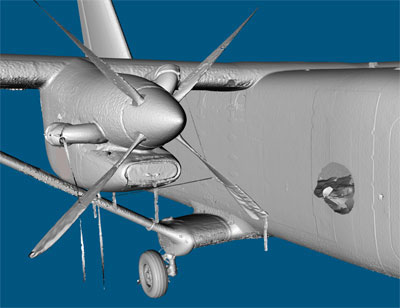
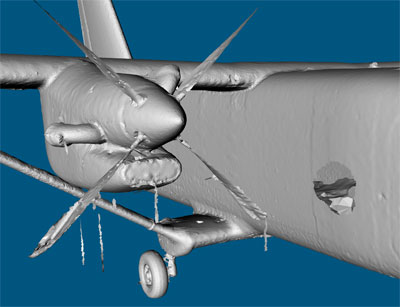
The study was conducted using airplane point cloud data provided by Aircraft Covers, Inc. To evaluate mesh reconstruction accuracy in VRMesh, we randomly sampled point clouds of varying densities from the indexed source dataset:
Each sampled dataset was converted into a mesh with a matching triangle count:
For consistency during comparison, all generated meshes were subsequently decimated to 3 million triangles before accuracy inspection.
The 50 million-triangle mesh was used as the reference model for all comparisons. Distance analysis was performed between:
The histogram results show that 99.839% of distances fall within the range of -0.022178 to 0.035795. This indicates extremely high agreement with the reference mesh, suggesting that reducing mesh density from 50 million to 10 million triangles preserves nearly all geometric detail with minimal deviation.
For the 5 million-triangle mesh:
Compared to the 10 million-triangle result, the distance distribution becomes noticeably wider and exhibits a positive bias.
For the 3 million-triangle mesh:
This mesh shows the largest deviation from the reference model. Although the distribution remains relatively balanced between negative and positive values, the broader distance range indicates increased geometric approximation and reduced surface fidelity at lower mesh resolutions.
The results demonstrate that mesh reconstruction accuracy decreases progressively as triangle count is reduced, while the overall global geometry remains highly consistent. Among the tested models, the 10 million-triangle mesh maintains excellent agreement with the 50 million-triangle reference mesh and preserves most geometric details with very small deviations. This suggests that it provides an effective balance between geometric accuracy and computational efficiency. As mesh resolution decreases further to 5 million and 3 million triangles, surface deviations become more apparent due to simplification effects and the gradual loss of fine geometric detail. Nevertheless, the reconstructed meshes still maintain strong overall structural consistency with the original reference model.
| ||||||