 |
 |
<< Blog | ||||||||||
| ||||||||||
Introduction and Objectives Real-time robotic perception requires balancing computational efficiency with geometric accuracy. While reducing point cloud density lowers processing time and computational load, excessive downsampling can remove critical geometric information needed for reliable navigation and environmental understanding. This case study examines how point cloud downsampling affects mesh reconstruction accuracy and segmentation consistency, with the goal of identifying point densities that minimize computational requirements while preserving sufficient geometric fidelity for robotic perception applications.
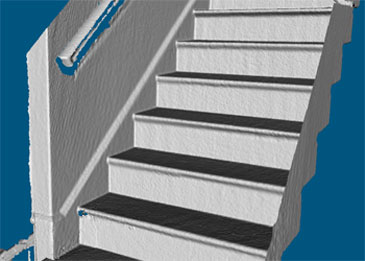
The study utilizes a residential staircase point cloud dataset acquired using a DotProduct depth camera scanner. DotProduct systems typically provide advertised scan accuracies ranging from 2 mm to 5 mm. For this analysis, a randomly sampled subset containing 3.3 million points was extracted from the indexed scan dataset and used as the baseline reference model.
The original 3.3 million-point dataset was progressively downsampled using uniform minimum-distance filtering. During this process, if the spatial separation between two points was less than a specified threshold, one point was removed. This procedure produced reductions of up to 99.8% in point count. The resulting datasets contained:
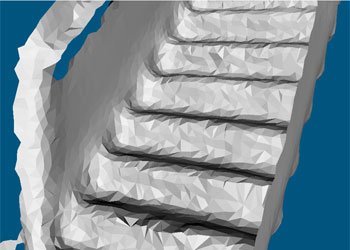
Each point cloud was converted into a surface mesh using VRMesh with a target maximum output of 4 million triangles. In practice, the achievable triangle count is constrained by the input point density and is typically limited to approximately twice the number of input points. The resulting mesh models were:
Mesh accuracy was evaluated by computing point-to-surface distances between each generated mesh and the original 3.3 million-point reference point cloud. The reference mesh (Stairs-Original) demonstrated high geometric fidelity, with 99.49% of absolute distances falling below 1.30 mm. The mean distance error was 0.33 mm with a standard deviation of 0.20 mm. For the downsampled datasets, the measured errors were:
These results demonstrate a predictable increase in geometric error as point density decreases. However, despite substantial reductions in point count, the reconstructed meshes retained the overall shape and structural characteristics of the original staircase model.
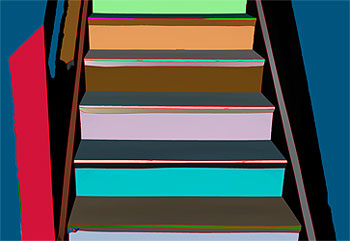
To evaluate segmentation consistency, the Stairs-Original mesh was decimated from 4 million triangles to 100,000 triangles and used as the segmentation reference model. Edge-based segmentation was then applied to all mesh datasets. Segmentation consistency was quantified by measuring distances between corresponding segmented regions of each downsampled mesh and the segmented reference mesh. The results were:
The segmentation results closely mirror the mesh accuracy analysis, with deviations increasing as point density decreases. Nevertheless, segmentation boundaries remained largely consistent across all datasets, indicating that the principal structural features of the staircase were preserved despite significant reductions in point count.
This case study demonstrates how aggressive point cloud downsampling influences both mesh reconstruction accuracy and edge-based segmentation consistency in VRMesh. The results reveal a clear trade-off between computational efficiency and geometric fidelity that is highly relevant to real-time robotic perception workflows.
Although mesh reconstruction error increased as point density decreased, segmentation consistency remained remarkably stable. Even for the lowest-resolution model (Residentialstairs45), the average segmentation deviation was less than 1 mm. The 25 mm to 35 mm downsampling thresholds appear to provide the most effective balance between computational efficiency and geometric accuracy for real-time robotic applications. At these thresholds, the dataset is reduced from millions of points to fewer than 20,000 points while maintaining average mesh reconstruction errors below 5 mm and preserving highly consistent edge-based segmentation results. These findings indicate that while downsampling removes fine-scale surface detail, it successfully preserves the macro-geometric features-such as edges, corners, and structural boundaries-that are most important for segmentation and navigation tasks.
These findings directly impact legged robots, such as quadrupeds or humanoids, which require rapid environmental mapping during locomotion. Processing millions of points stalls footstep planning algorithms, causing the robot to freeze mid-stride or misplace a limb. Downsampling to a 25-35 mm threshold slashes computational latency from seconds to milliseconds by reducing the data load to under 20,000 points. Because structural edges are preserved within a sub-millimeter average error (0.21-0.61 mm), the robot's perception system can accurately identify the rise, run, and lip of each step. This optimization ensures fast, safe, and stable foot placement in real time.
The results in this VRMesh case study indicate that substantial reductions in point cloud density can be achieved while maintaining acceptable levels of mesh reconstruction accuracy and segmentation reliability. For real-time robotic perception applications, downsampling to approximately 25-35 mm spacing - cutting up to 99% of points - provides a practical balance between computational efficiency and geometric fidelity, enabling robust environmental understanding without the overhead associated with processing millions of points.
| ||||||||||